
The Piece That's Still Missing After 20 Years of Email
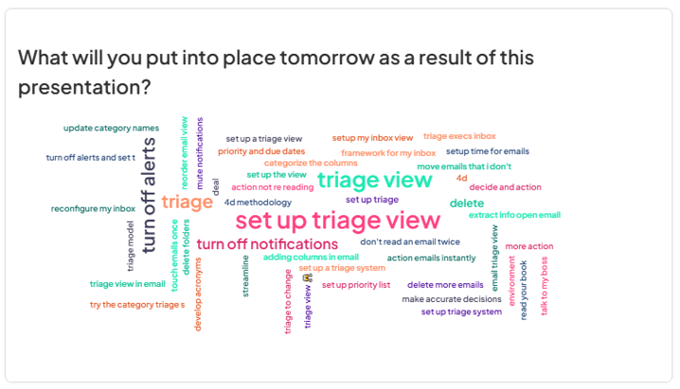
At both recent ThinkTank EA Summits, I closed my session with a simple prompt: "What will you put into place tomorrow as a result of this presentation?" I ask this deliberately, because the answer tells you far more than a satisfaction survey ever could. It reveals the gap between what people already know about email and what they're actually doing with it day to day.
The responses were telling, as you can see in the graphic below. Overwhelmingly, EAs — many with 20 years or more of experience running inboxes — pointed to the same missing piece: structure. Not more effort. Not a better attitude. Structure. Specifically, a way of deciding when to process email, what to do with each message, and where commitments should live once a decision has been made.
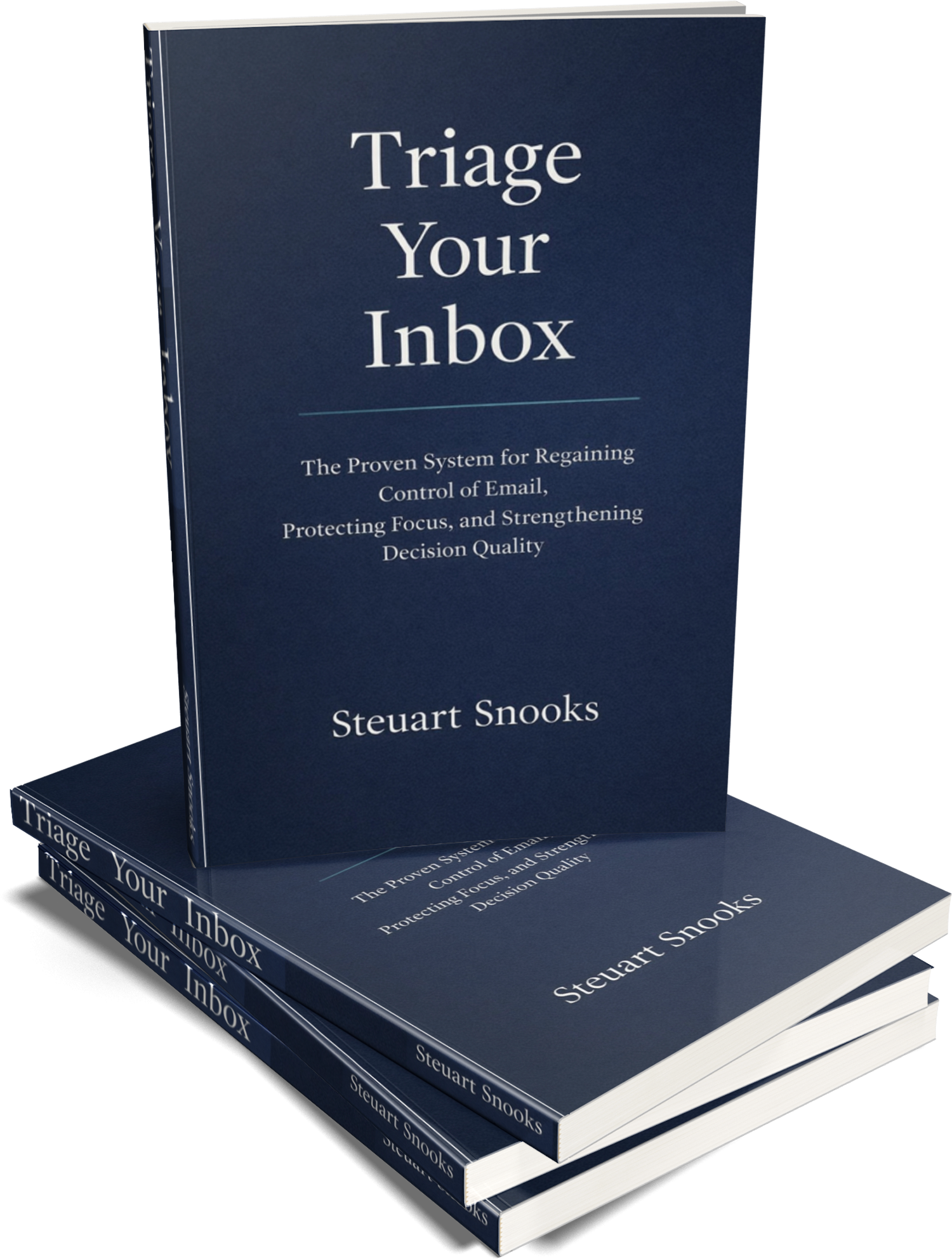
That's not a coincidence. It's exactly the gap I describe in my new book called ‘Triage Your Inbox’ as the WHEN, WHAT, WHERE framework — and it's worth understanding why so many experienced professionals are still missing it after two decades of daily email use.
WHEN — the most important variable. Most professionals manage email reactively: processing it whenever it arrives, between meetings, during breaks, after hours. This reactive pattern is the root of most inbox dysfunction, because decisions made in an interrupted, divided-attention state are consistently worse than decisions made during dedicated, focused processing. The fix is counterintuitive but powerful: treat email like a meeting. Schedule dedicated processing blocks, give email your full attention during those blocks, and close the inbox outside them.
WHAT — clarifying the next action. Even when we give email our full attention, the most common failure is reading without resolving — scanning a message, registering its general nature, and moving on without deciding what actually needs to happen. The antidote is "next action thinking": identifying the single concrete next step an email requires, expressed specifically enough that the mental loop can actually close. Not "sort out the proposal," but "call Marcus Friday to confirm proposal terms."
WHERE — trusted storage system. The third and often most overlooked piece is knowing where a commitment lives once you've decided what to do with it. The answer is never the inbox. Without a trusted system — a calendar, a task manager, a structured follow-up list — actionable emails stay parked in the inbox, where they become indistinguishable from everything else arriving on top of them. Priority disappears. Critical items get buried. And the inbox turns into a to-do list that everyone else can also write on.
What's striking about the "what will you put into place tomorrow" responses is how many EAs recognised, often for the first time, that they'd never actually been taught this. They'd built folder systems, flags, and their own private workarounds — but no one had ever shown them a structured way to decide when email gets their attention, what they're going to do with it, and where it goes once a decision's been made. That's not a personal failing. It’s the predictable consequence of operating without a system in a context that desperately requires one. As I write in the book, almost no professional has ever received formal training in how to manage email as a system — despite it being, for most of us, the primary channel through which our entire workload arrives.
The encouraging part of these responses was the shift in energy once the concept of this framework ‘clicked’. EAs weren't leaving with vague resolutions to "try harder" or "check email less." They were leaving with something specific: a scheduled processing block to trial this week, a next-action habit to apply to every message, a trusted system to capture ‘what’ and ‘when’ commitments instead of leaving them sitting in the inbox. That's the difference between insight and implementation — and it's exactly the shift Triage Your Inbox is designed to help make permanent.
Ready to Put the Structure in Place?
Register Your Interest in the ‘Triage Your Inbox’ Book
If you are interested in being one of the first to receive a copy of my new book ‘Triage Your Inbox’, please click below to register.

Learn More About Triage Your Inbox Programs
If you’ve recognised some of these challenges in the way you manage email, the next step is to put a structure in place that works.
Triage Your Inbox provides a practical framework for deciding when to process email, what to do with each message, and where to keep the commitments that matter.
Find out how you can move from simply managing your inbox to being genuinely in control of it.