Why Every Email Fix You’ve Tried has Failed
At the recent ThinkTank EA Summits, I asked attendees a simple question: “what have you already tried using to manage your email?” The results, seen in the graphic below, tell a clear story.
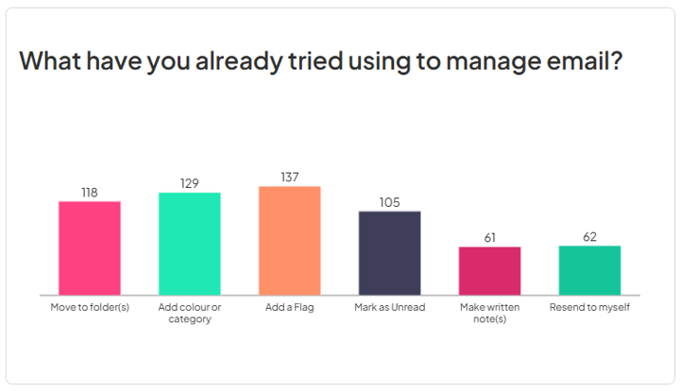
What strikes me isn't any single number — it's that every one of these tactics is well represented. These aren't rare, obscure workarounds. If you're reading this list and thinking "yes, I've tried most of those," you're in good company. They're the default toolkit almost every professional has used for 20 years or more, especially for emails that can't be completed straight away. And here's why none of it truly works: every one of these tactics does the same thing psychologically. It creates an open loop.
Psychologists use "open loop" to describe an unfinished commitment your brain won't let go of. The moment you read an email, register that something needs to happen, and close it without making a decision about it, you've created an open loop. Your brain doesn't release it just because you've done something that feels like progress. It keeps that item in working memory, quietly monitoring for the moment you'll come back and finish the job. But working memory wasn't built to hold dozens of these unresolved threads at once. Each one, alone, is trivial. Collectively, they're what makes an inbox feel unbearable long before you've actually done anything with it.
And the cognitive weight compounds every time you re-read a message: the email you glance past at 9am feels a little heavier by 2pm, heavier still by the next morning, even though nothing about the email itself has changed. That's not a mood. It's cognitive residue building up with every unresolved pass.
The knock-on effects are exactly what most people describe as "just how email feels": a low-grade anxiety that doesn't go away even when you're not looking at your inbox, difficulty concentrating on the task in front of you because part of your attention is still tied up in everything left undecided, and the pervasive sense of being behind no matter how hard you're working. It's the inevitable output of a brain doing exactly what it's designed to do with unresolved commitments — hold onto them. None of that is a personal failing. It is the predictable consequence of operating without a system in a context that requires one.
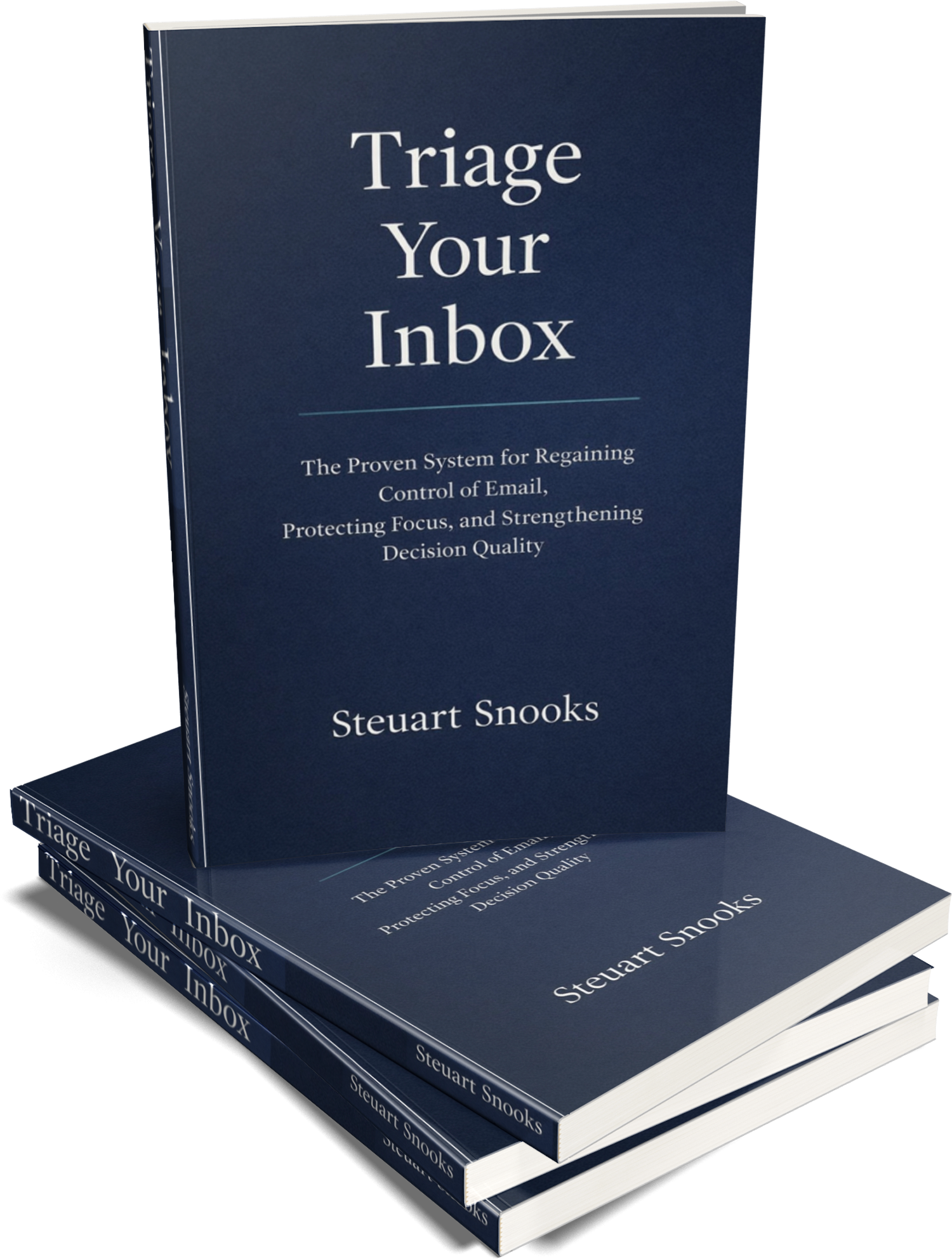
That's the whole premise behind the 4D framework I explain in my new book ‘Triage Your Inbox’: every email gets one of only four decisions — Delete, Deal, Delegate, or Decide — the first time you touch it. Not moved to a folder for attention someday. Not a flag "for later." Not a colour that means something today and nothing next week. Each email gets a decision, with a clear next action and a clear "when," if it can't be dealt with immediately. That way the loop actually closes instead of just looking closed.
If your current system is a flag, a folder, or one of the other strategies, you're not doing anything wrong — you're doing what almost everyone in that conference room is also doing. But when you can configure your email software to help you capture the next action and due date for emails that can't be completed the first time you read them, you close the loop and free up mental bandwidth and headspace. Your system carries the load — you carry only the thinking and decision-making.
Register Your Interest in the ‘Triage Your Inbox’ Book
If you are interested in being one of the first to receive a copy of my new book ‘Triage Your Inbox’, please click below to register.