Protecting Your Executive's Focus Time: The Inbox Is Usually the First Leak
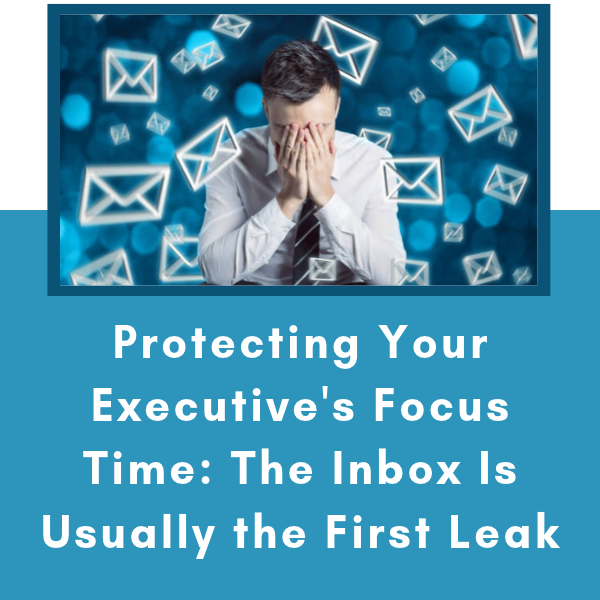
Nicky Christmas has written an excellent piece on why protecting your executive's focus time is one of the highest-value things an EA can do, called Protecting Your Executive's Focus Time for Better Productivity". I agree with every word of it. But after 25 years of working with executives and their support teams, I'd add one thing: when focus time goes missing, the inbox is very often where it went.
Interruptions don't always knock on the door
Nicky points to Sophie Leroy's research on attention residue: when we switch tasks, part of our attention stays behind on the last one. Gloria Mark's work adds that interrupted people may work faster, but they pay for it in stress and frustration.
Now think about how most executives work. Microsoft's 2025 Work Trend Index found people are interrupted roughly every two minutes, and the average worker receives well over a hundred emails a day. Every notification, every glance at the unread count, every "I'll just check quickly" between meetings is a task switch. Each one is a task switch, and each switch leaves part of their attention stuck on the email they just glanced at, rather than on the work in front of them.
Email is a uniquely sneaky interruption because it is self-inflicted. Nobody walks into the office. The executive simply opens their email, and fifteen minutes of strategic thinking quietly becomes fifteen minutes of reacting to other people's priorities.
Email is cognitive load, not just a time cost
An unprocessed inbox is a pile of undecided decisions. Each message sitting there, read but not actioned, is a small open loop the brain keeps returning to. That is why an executive can block two hours for thinking work and still feel scattered: the inbox comes into the room with them.
Nicky's warning signs that focus has slipped are worth watching for: decisions rolling over, strategic work drifting into the evening, small errors creeping in. In my experience, a bloated inbox and evening email sessions usually show up at the same time.
Build focus blocks that email can't breach
Nicky recommends agreeing the purpose of each focus block, scheduling it before the week fills up, putting it in peak thinking hours, and protecting it like a board meeting. All good advice. I'd add a few email-specific safeguards:
Close email completely during focus blocks. Minimising the window isn't enough; turn off notifications and the desktop alert.
Schedule set times for processing email either side of the block, so the executive knows nothing is being neglected.
Prepare the block in advance, including pulling any emails or attachments they'll need into one place (preferably the ‘focus time’ entry in their calendar), so they don't have to go hunting in the inbox (and get caught there).
Agree what counts as a genuine emergency and how you'll reach them if one happens. Usually that's a phone call or a tap on the door from you, not an email.
Be the filter, not just the gatekeeper
Nicky's script for the "just five minutes" request is spot on: offer an alternative time, or ask the person to send the question so you can make sure it's seen. That’s where scheduling regular ‘Office Hours’ makes it easy for everyone to know when your Executive will be available. Click here to read my article about the ‘Office Hours’ strategy .
This is where the inbox becomes the EA's most powerful tool. If you can sort incoming email using the 4D Decision Tree (Delete, Deal, Delegate, Decide), most messages never need to reach your executive's attention at all. What does reach them arrives as a curated, decision-ready set of items rather than as a steady drip of raw, unprocessed information throughout the day.
Take decisions off the plate, and out of the inbox
Nicky suggests sorting decisions into three groups: those only the executive can make, those the EA can make and report later, and those the EA can handle autonomously. Apply the same thinking to email. Agree which messages you'll answer on their behalf, which you'll draft for approval, and which genuinely need their eyes. Every message you take off their plate is one less attention switch, one less open loop, and one less reason to open the inbox mid-thought.
Protect your own focus too
EAs often live in the inbox, so this applies doubly to you. Block time for your own thinking work, agree response windows with your executive, and resist the urge to check email every few minutes just because you can. Being responsive doesn't mean being constantly reactive.
The bottom line
Protecting focus time is about calendar strategy, boundaries, and delegation, as Nicky rightly says. But if email is left unmanaged, it will leak through every one of those defences. Get the inbox under control and the focus time you protect will actually be used for focused work.
Ready to protect your executive’s focus time?
If email is constantly interrupting your day and getting in the way of important work, let's talk.
Book a Free Email Optimisation Strategy Call with me to discuss your challenges and explore practical ways to improve email management, reduce interruptions and reclaim time for what matters most.
Where possible, it’s best if your executive can join the call too, so we can discuss the challenges together and identify the most effective way forward for both of you.
