Volume Isn't the Problem — It's the Symptom
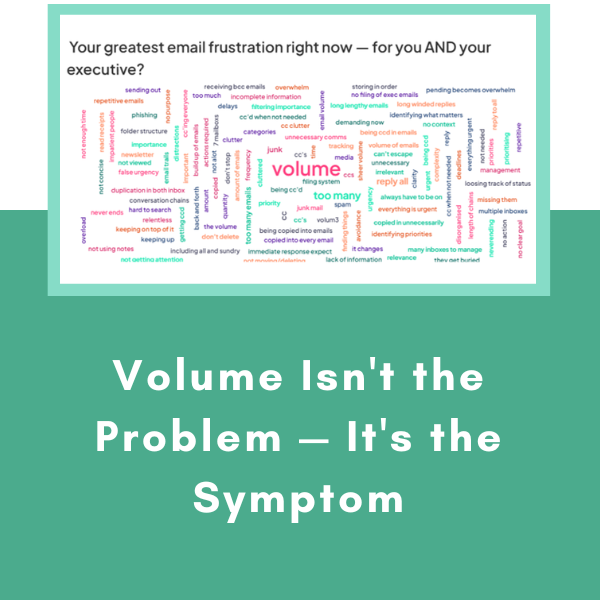
I recently surveyed conference attendees on their single biggest email frustration. We turned every response into a word cloud, and the result wasn't subtle. One word towers over everything else: volume.
It's easy to see why. Look at the words clustered around it — too many, reply all, cc's, junk, spam, cluttered, overwhelm. Whether it's a barrage of ccs nobody asked to be part of, reply-all threads that balloon past their usefulness, or a general sense that email "never ends," the sheer volume people are wading through every day is real.
But here's where most diagnoses go wrong: they stop at volume.
If it were really about volume, the people with the biggest inboxes would always be the most overwhelmed. In practice, that's not what happens. I've worked with executives receiving several hundred emails per day who function calmly, and with professionals drowning in a fraction of that. The difference was never the number of emails arriving. It was whether there was a system for handling them.
Zoom out from "too much email" in the survey results and a second pattern appears, sitting quietly underneath the first. Terms like no filing of exec emails, storing in order, categories, tracking, identifying what matters, no context, disorganised, and lack of information aren't complaints about quantity. They're complaints about the absence of a process for making sense of the quantity. Volume becomes unbearable specifically when there's nothing in place to sort it, triage it, or decide what deserves attention and what doesn't.
The Standardisation Gap
Think about how carefully organisations standardise every other high-stakes workflow. There's a formal process for raising a purchase order, submitting expenses, approving leave, managing compliance. These exist because inconsistency creates risk. Yet email — the channel through which the majority of real decisions, commitments, and escalations actually flow — usually has no standard process at all. Everyone builds their own survival strategy, and every strategy is different. That's not a technology problem. It's a systems problem — what I call the standardisation gap.
Two people can receive the exact same 100 emails a day and have completely different experiences of it. One drowns, because every message gets opened, half-read, left "to deal with later," and revisited three or four times before anything actually gets decided. The other processes the same 100 without a ripple, because they're running a system that allows them to quickly make an appropriate decision for each email and capture what and when is needed for any emails they can't process immediately — so nothing gets touched twice waiting on a decision that was never actually made the first time.
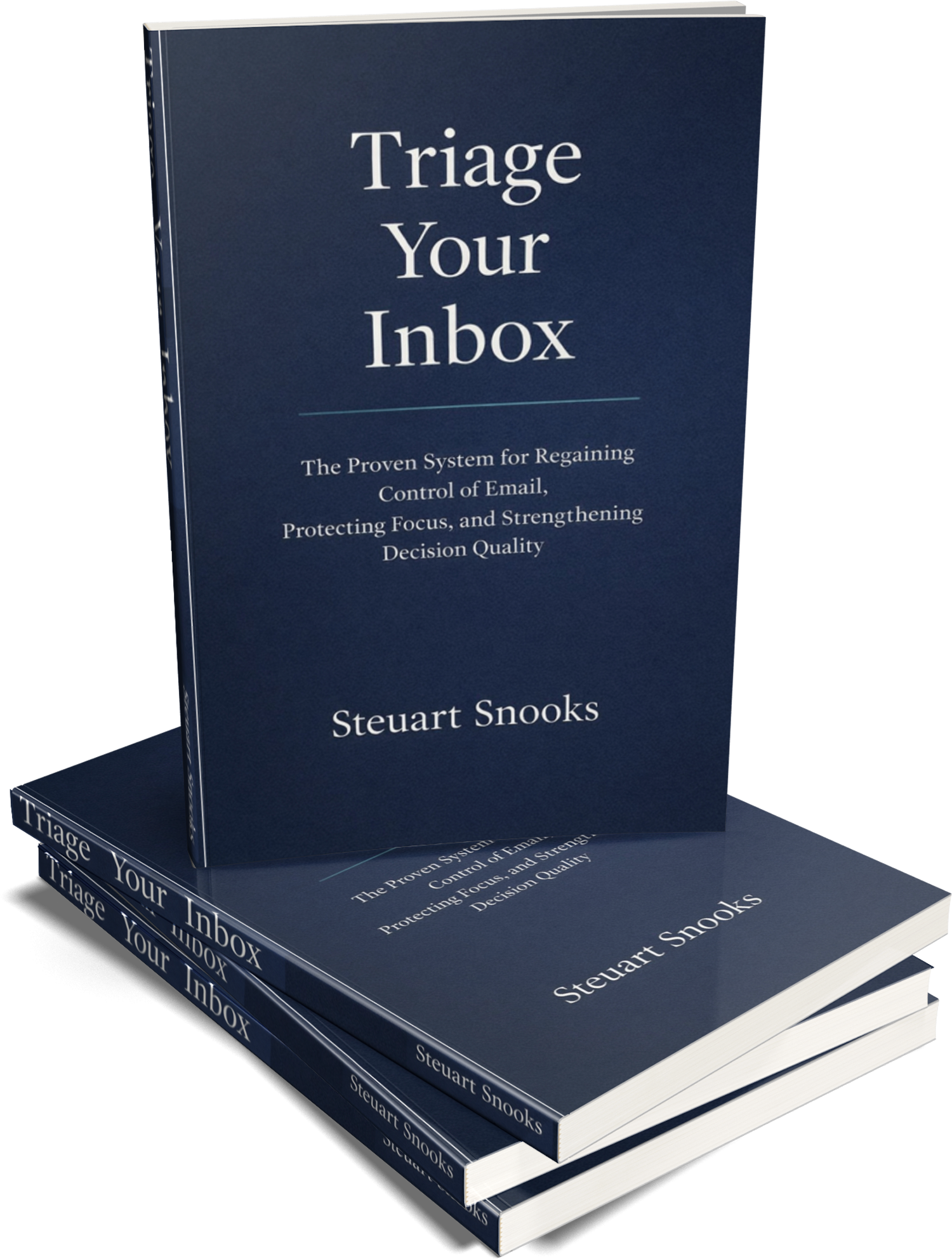
That's the whole premise behind the Triage Operating System in my new book ‘Triage Your Inbox’: every email needs exactly one of four decisions — Delete, Deal, Delegate, or Decide — made the first time you touch it. There's no "flag for later," no "I'll think about it." Four decisions. Every time.
Once that single-touch discipline is in place, the same inbox that felt like the word cloud — cluttered, urgent, never-ending — starts to feel like something closer to the transformation one of my Executive Clients described after learning the Triage Operating System;
““As a new senior Executive, I was overwhelmed by the email traffic. I felt like I was hit by a tsunami that just wouldn’t stop! A week later and my inbox was under control - I was surfing the tsunami not drowning””
None of this dismisses volume as a non-issue. CC culture, reply-all reflexes, and junk mail genuinely deserve to be minimised, and that's worth tackling head-on. But even if every organisation solved cc-creep overnight, without a process for triaging what remains, the feeling of overwhelm would barely change. If you (or your executive) feels like you’re ‘drowning’ in email volume, the real question isn't "how do I get fewer emails?" It's "what system decides, the first time I handle an email, what happens to it next?" That's the problem Triage Your Inbox was written to solve.
Register Your Interest in the ‘Triage Your Inbox’ Book
If you are interested in being one of the first to receive a copy of my new book ‘Triage Your Inbox’, please click below to register.